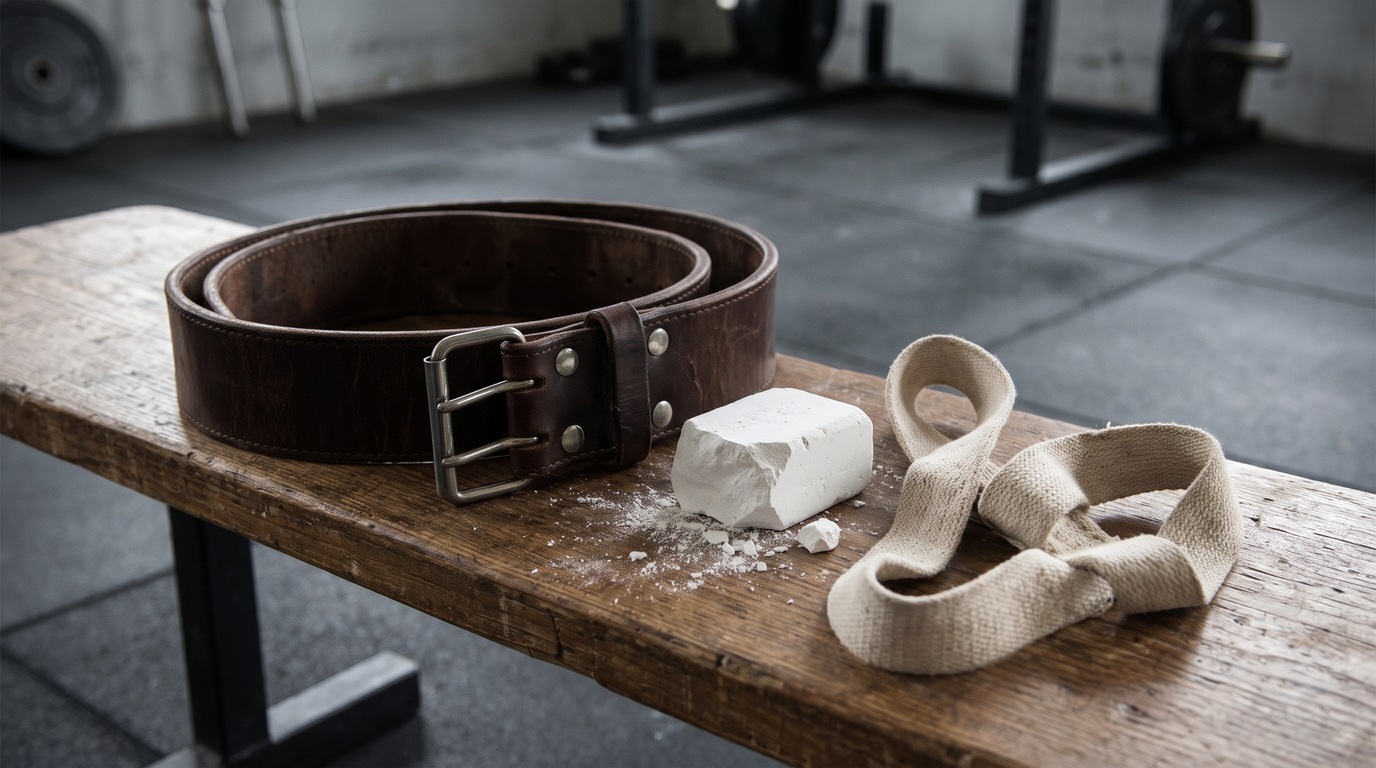
Quick answer: chalk and a pair of lifting straps are the cheapest accessories worth owning, because they solve a grip problem without changing how you lift. A belt, wrist wraps and knee sleeves are optional, and each helps in specific cases. Start with one or two items you will actually use, and add others only when a real problem shows up in training.
This is general information about gym accessories. Equipment does not replace good technique, and it cannot treat an injury. Speak with a qualified coach or a physician if you have pain or questions about your own training.
In this guide
Why accessories are easy to overbuy
Gym stores and product pages sell accessories as if every lifter needs a full set. In practice, each item solves a narrow problem. If you do not have that problem, the accessory is clutter. Ask what problem you are trying to solve before you add anything to a cart.
Chalk
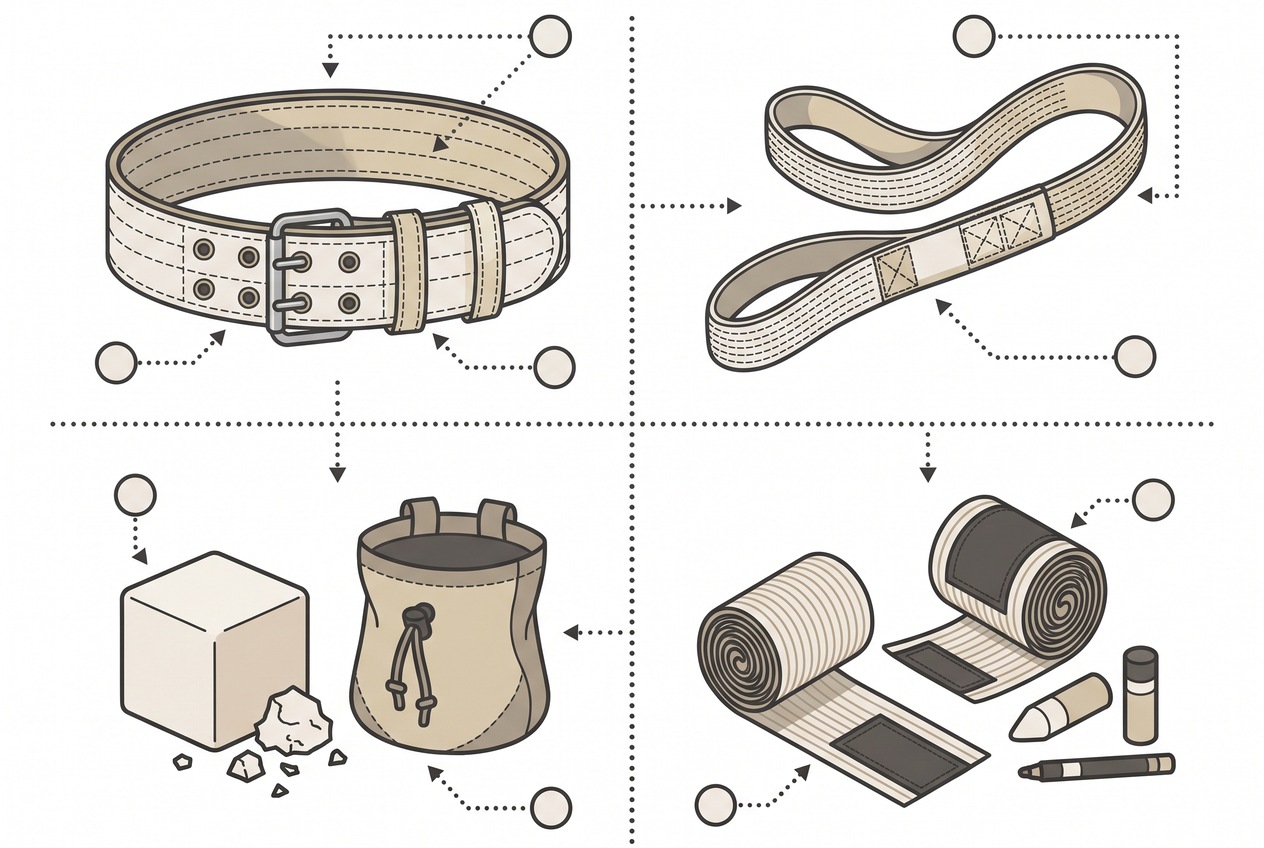
Chalk absorbs moisture from your hands and improves grip. It is cheap, light and useful for deadlifts, pull-ups and heavy rows.
Chalk comes as blocks, loose powder and liquid. Blocks are the simplest and least messy, loose powder is easy to apply, and liquid chalk dries to a thin film and leaves less dust. Some gyms ban loose chalk, so check the rules if you train away from home.
At home, chalk dust gets into the knurl and onto floors. Brush the bar after use and keep a small tray for the block.
Lifting straps
Straps wrap around your wrists and the bar so your grip does not limit a pull. They are used on heavy deadlifts, rows and shrugs.
Cotton straps are the common choice. They are inexpensive and hold well. Nylon straps are slicker and can slip. Check the length and width, since longer straps wrap more easily.
Use straps on the heaviest sets and keep working your grip on lighter ones. If you use straps for everything, your grip may lag behind your back.
Lifting belts
A belt gives your abdomen something to brace against, which can make heavy squats and deadlifts feel steadier. It does not replace core strength, and it should be worn tightly only for the heavy sets.
Belts come in leather and nylon, in lever, prong and Velcro styles. Leather belts are stiff and last long. Nylon belts are lighter and flexible. A lever belt tightens quickly, a prong belt adjusts finely and a Velcro belt is the easiest to take on and off.
Check the width and thickness. Many belts are about 4 inches wide at the back, with a uniform width. A stiff belt of about 10 mm is common for powerlifting, and thinner belts suit general training.
| Accessory | What it helps | Typical cost range | Who needs it |
|---|---|---|---|
| Chalk | Grip | Low | Most lifters |
| Straps | Grip on pulls | Low | Lifters doing heavy pulls |
| Belt | Bracing | Moderate | Lifters at heavy loads |
| Wrist wraps | Wrist support | Low | Heavy pressers |
| Knee sleeves | Warmth and compression | Moderate | Some squatters |
Wrist wraps and knee sleeves
Wrist wraps stiffen the wrist on heavy presses, which can make the bar feel steadier. They are not needed for light work. Wrap them firmly, and remove them between sets.
Knee sleeves are neoprene tubes that add warmth and light compression. Many lifters like the feel. They are not a treatment for pain, and they do not replace a proper warm-up.
Sizing and fit
A belt that does not fit properly will not brace well. Measure your waist at the point where the belt will sit, usually around the navel, and compare the measurement to the maker’s size chart. If you are between sizes, check how much adjustment the belt allows. Lever belts have set holes, while prong and Velcro belts are easier to adjust.
Wrist wraps come in different lengths, and a longer wrap gives more support but takes longer to put on. Straps come in different lengths too. If a strap is too short, it will not wrap enough times to hold the bar.
When accessories hide a problem
An accessory can cover a weakness for a while, but it does not fix it. If your grip fails on every deadlift, straps will help you finish the set while the grip stays weak. If your back rounds under load, a belt will not correct your form. Use accessories to support a good movement, not to replace one. A qualified coach can watch your lifts and tell you whether the problem is equipment or technique.
What to skip at first
- Straps, belts, wraps and sleeves all at once.
- Gloves, which can reduce grip feel and wear out.
- Weighted vests and chains, unless your program calls for them.
- Gadgets that promise to fix technique.
How to choose a first set
- Pick a problem. Is your grip failing, your bracing slipping or your wrists bending?
- Buy the cheapest accessory that fixes that problem.
- Use it for a few weeks and note whether it helps.
- Add another item only if a new problem appears.
- Keep receipts, since fit matters and returns are sometimes needed.
Care and storage
Leather belts should be kept dry and wiped down. Straps can be washed and air dried. Chalk should be sealed in a container so it does not dry out or spill. Wraps and sleeves can be washed according to the label.
The bottom line
Chalk and straps solve grip problems cheaply. Belts, wraps and sleeves help in specific cases and are optional. Start with the accessory that fixes your real problem, use it consistently and add others only when needed.